

Ryan Ladd ‘29
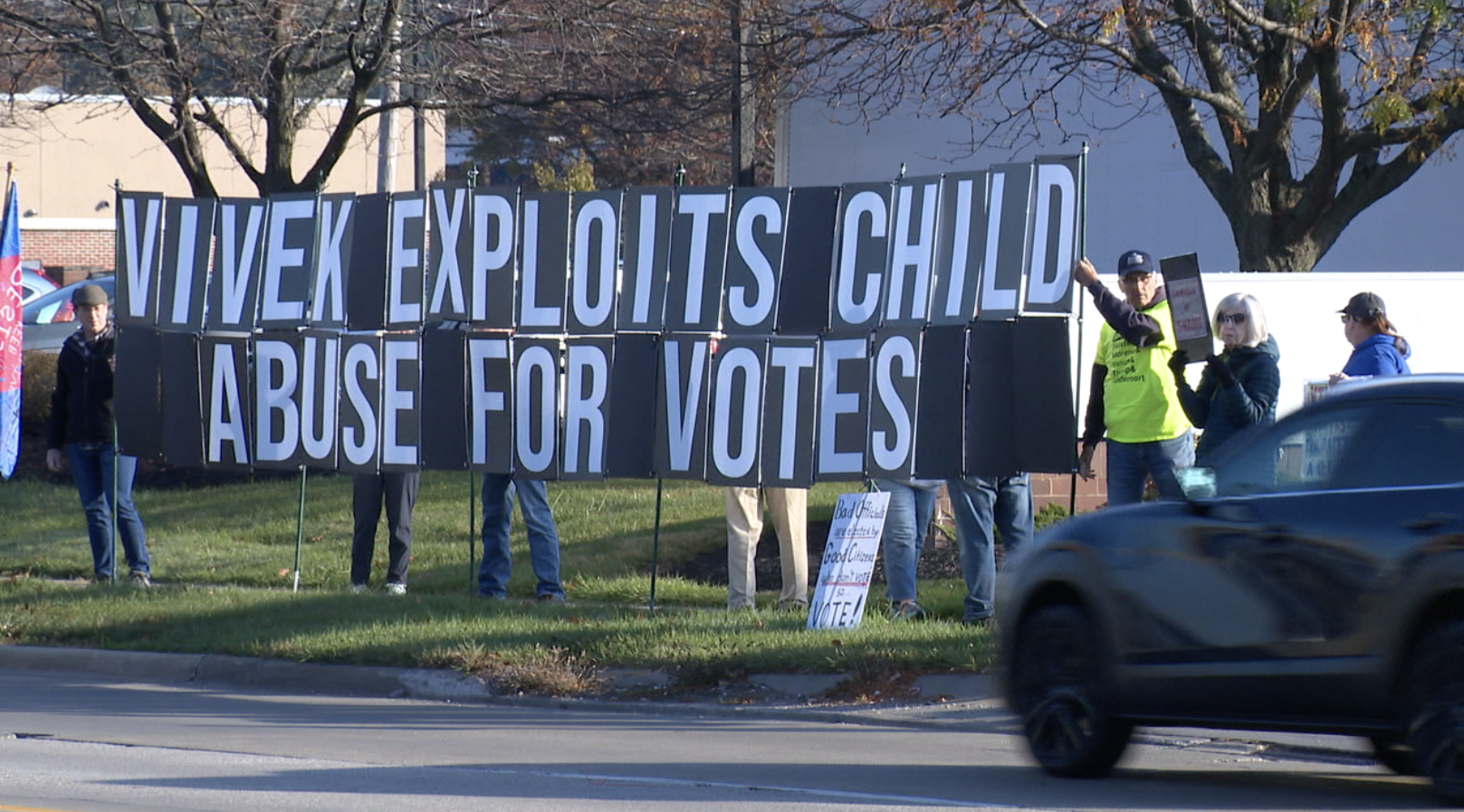
Photo from News 5 Cleveland, WEWS-TV
On Monday, Oct. 19, an advertisement by Ohio gubernatorial candidate Vivek Ramaswamy’s campaign began circulating on the internet and garnering negative opinions. The ad featured Donna Arthur — the mother of Ramaswamy’s opponent Amy Acton — calling Acton a liar and discouraging Ohioans from voting for her. Records quickly proved, though, that Acton had been estranged from her mother for decades, after Arthur’s second husband was charged with raping Acton from the ages of 9 to 12. Acton’s mother defended her husband and fled from their town with him to avoid trial. In the ads, Arthur claims that Acton “lies about her past,” and that she cannot help the people of Ohio if she “needs help herself.” Acton, now 60 years old, has not spoken to her mother since she was 12.
The ad was immediately met with extreme criticism from both Democrats and Republicans, who recognized that the claims made were incredibly distasteful. President Trump took to Truth Social, where he defended Ramaswamy, calling the ad “powerful,” saying that calls for Ramaswamy to take the ad down were a “concerted and well-coordinated attack” by the press. For most viewers, the ad was deeply disturbing and marked a new low for current politicians.
Attack ads in politics are nothing new. During the 1964 presidential election, Lyndon B. Johnson’s campaign used an ad to attack Barry Goldwater, criticizing his beliefs about the use of nuclear weapons in the Cold War. The ad showed a little girl picking flowers before a nuclear explosion went off, forcing voters to question if they wanted a president who was pro-nuclear warfare. In 2008, John McCain targeted Obama in an ad, placing him amongst Britney Spears and Paris Hilton as “the biggest celebrity in the world,” insinuating that he is just a big name, not a true leader. While harsh and even disturbing ads have been used in former campaigns, it seems that the subject matter of Ramaswamy’s ad was especially cruel. The ad spotlighted a truth that is becoming increasingly more obvious in American politics: we are losing our standards of decency in our current climate of extreme polarization and partisanship.
Sarah Lawrence College professor David Peritz covers topics just like this in his course Deranged Democracy: How Can We Govern Ourselves if Everyone Has Lost Their Minds? He cites political scientist Liliana Mason, who has done extensive research on American political attitudes towards people of opposite party affiliations. In her studies on radical partisanship, she found that close to 20% of Americans can barely see the opposing party as humans. To Peritz, this ad likely came out of this very mindset. “You wouldn’t go find the estranged mother of a candidate who exposed her daughter to sexual abuse as a child and ask her to film a commercial if you didn’t think that your opponent deserves no respect or has no worth,” Peritz reasons. “We have become so divided politically that we don’t think we need to moderate our political communication by standards of human decency.” Peritz also asserts that this is not a one-party issue. While many people have taken to social media to call out the Republican party following Ramaswamy’s ad, Democrats have also “played dirty.” Across the board, politicians have devolved into an era of “nasty politics,” as Peritz puts it. “That’s politics. It’s a messy contact sport and it attracts a lot of people who want power, and who have limited scruples about how to get it.”
The negative campaigning strategy is starting to move far beyond just television ads. As Artificial Intelligence (AI) usage becomes more prevalent, it seems that the means for creating disrespectful attack content has only increased. President Trump recently posted an AI video depicting his political adversaries as animals, including the Obamas as apes. Social media in general has really changed the dynamics of partisan politics. Politicians can post content spewing hateful rhetoric about their opponents, and their supporters have convenient access to it. David Peritz suggests that moving from large-scale broadcasting to the narrowcast that social media provides has contributed to standards of decency disintegrating. Since television is broadcast everywhere, public discourse must be more inclusive and acceptable to different kinds of people. Social media algorithms allow for specific content to reach mostly the people who are interested in it. “As we’ve moved into narrowcast media in which you are only trying to get the people who already agree with you to tune in, we’ve moved away from respectful, tolerant political discourse and in the direction of hyperpolarized dehumanizing,” Peritz explains. “The media is shaping our discourse, our political attitudes, and our emotions in a way that is deleterious to democracy and to our ability to get along with each other.”
Responses to Vivek Ramaswamy’s attack ad from Democrats and Republicans alike may be evidence that Americans are exhausted by this ruthlessness in politics. It seems that in the era of Trump as president, it has become acceptable for politicians to discard the principles of consideration and to be aggressive towards one another. It has destroyed our ability to communicate with those we do not see eye to eye with. As people of opposing parties cannot see political opponents as human beings, it is apparent that partisanship in our current political understanding has gone too far.