Experiential Learning Center Opens Its Doors Amid Budget Concerns
Katie Oravecz ‘29
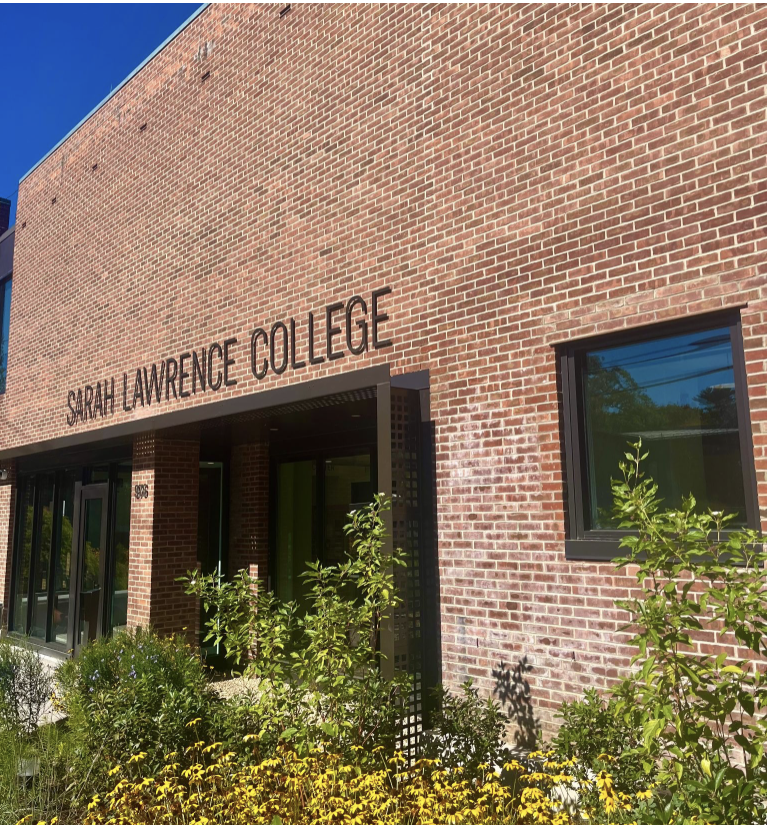
Photo by Katie Oravecz ‘29
On Sept. 4th, after twelve weeks of construction, the brand-new Experiential Learning Center (XLC) opened its doors to the public. The new building, constructed in a renovated part of the Performing Arts Center (PAC), houses Career Services, Community Partnerships, Global Education and SLCEmbeddEd. The ground floor includes a common area with workstations, a kitchen, soundproof learning pods, and the offices of the heads of the XLC departments, while the second floor houses two classrooms. The project also included renovations to the HVAC system in the PAC.
According to Dave Stanfield, Dean of Students and Vice President of the college, the school planned to adapt the old bookstore in the PAC into a “space to benefit current and new students.” The planning for the center took two years in total, with the total project costing approximately 6 million dollars. Stanfield stated that the project was financed through a mixture of philanthropic support, capital investment as well as a New York State Higher Education Capital Program (HECaP) grant of $1.5 million obtained by the college. “Those resources are not interchangeable with the dollars we use each year for salaries, programs, and other operating expenses,” he clarified.
The idea for the XLC was to create a space that would integrate a vision of continued focus on experiential learning and improve accessibility of the services available to students. According to Stanfield, it “came from the administration recognizing feedback over the years that some of these offices are located in really disparate locations…and that was a barrier to exploring different opportunities.” Previously, the offices housed in the XLC were all located in various buildings across campus, making collaboration difficult. According to the head of Career Services, Angela Cherubini, “that was probably part of the decision-making, to bring us more front and center…that alone sends a signal of building this culture of how important this work is.”
“It’s an opportunity to work in a more cooperative and more cohesive way that benefits students,” said Prema Samuel, head of Global Education. “The resources always existed. It’s just that we contained them all into one space.”
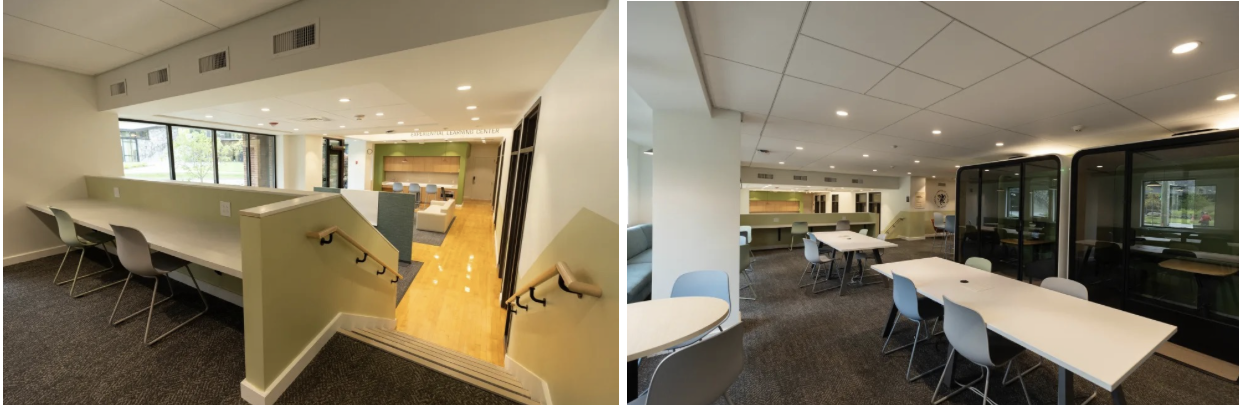
The interior of the XLC with working areas and sound-proof pods. Photos via sarahlawrence.edu
The new building has been met with mixed reception from students, as many of them expressed frustration about spending on a new space while other parts of campus life face budget cuts. “I think it’s a waste of resources,” said sophomore Lilian Blount ’29. “They could have put the money into something else.” Colleges are reportedly struggling across the country with enrollment rates declining, with the Trump administration's increasing attacks on institutions adding extra pressure. As outlined in The Hechinger Report, colleges experienced a 15 percent decline in enrollment between 2010 and 2021. Hampshire College, a school with a very similar educational model to Sarah Lawrence, permanently closed down beginning this Fall semester, citing financial concerns. Higher education is facing a dark era, and liberal arts colleges like Sarah Lawrence are bearing the brunt of it. This has not gone unnoticed by students. “I think it’s a building that helps students to be more efficient, and it is a space that we need on campus. However, I wonder if it was the best allocation for resources given the other needs students have,” stated Rofayda Fayed ‘29.
Stanfield responded to these concerns by pointing out the peculiarities of the school budget. “Our annual operating budget and our capital investments are different, and capital projects are financed differently from our day-to-day operations.” He stated he understood the concerns, but pointed out the need for different kinds of investment. “It’s always a balance between these things and trying to raise money for a variety of different things, but there's a recognition that this was a sort of deficit, or something that was missing for the college, and that if we wanted to be relevant into the future, that we needed to lean more heavily into experiential learning.” According to Stanfield, all capital projects are approved by the Board of Trustees.
These types of investments aren’t unusual for colleges; if anything, according to Samuel, Sarah Lawrence is “late to the game” when it comes to spaces like this. “Certainly, when I'm out talking to my colleagues at other colleges, promoting study abroad, it's not uncommon to see this structure.”
“I don't feel we've done a good enough job in preparing students for postgraduation. And that is, for me, what I see as a primary role of this office. We need to better prepare you for a life outside of Sarah Lawrence,” Samuel asserted. “It's important that people understand how we are connected. And the siloing doesn't help that message. And so the purposefulness of bringing us together…it’s really designed for you as a student to feel more equipped to deal with what's going to happen for you post Sarah Lawrence.”
The project to expand experiential learning received another blow over the summer: On Sept. 4, the same day the XLC opened, the International Student Office announced in an email to the community that the college decided to suspend all CPT authorization for international students based on a new broadcast message issued by the government in August, thus severely limiting the ability of international students to obtain internships. Stanfield emphasized that the college would continue to support international students; however, they should “meet individually with International Student Services before pursuing any employment opportunity.” College President Cristle Collins Judd stated in an email to the community that “Sarah Lawrence intends to support any potential litigation efforts challenging this action.”
“We do encourage international students to seek us out; it's on an individual basis, depending on what their needs are, but we can help them navigate this whole project,” Cherubini affirmed.
According to the department heads, they have received positive feedback from students who have come in contact with the XLC. “They love the space every time they come in,” stated Nelson Rodriguez, head of Community Partnerships. “Especially with the students who are doing volunteer work from community partnerships.” Mackenzie Weiler ‘28, who is planning to study abroad next semester and attended the open day for the XLC, was positive about the space. “I like that Global Education is more central to campus and that there is a designated space where we could all meet.”
Rodriguez also pointed out the encouraging response from external partners to the new space. “Everybody's been very excited to come visit our campus and visit our building.” Meghan Jablonski, head of SLC EmbeddEd, emphasized the usefulness of building those connections with external partners: “It’s not just for the sake of community connections, but it’s for creating opportunities for students.”
Cherubini emphasized the need to extend the mission of XLC to all parts of the campus. “We need to reach the students who don’t necessarily seek us out,” she stated. And I see that already happening…I'm having students just walking through the space just to check it out. Those are students we might not have crossed paths with.”
The opening of the XLC comes in the midst of a growing uncertainty regarding higher education. In many ways, this new space embodies the disconnect between students and the administration that seems to serve as the backdrop to this academic year. It also provides an insight into the priorities of the college moving forward. Certainly, the XLC will serve as a test of the college’s mission and whether or not it can reach the students who are most skeptical.
Still, people like Cherubini are optimistic. While the center is still in its early stages, she described a variety of opportunities and potential ideas, including scheduling LinkedIn workshops, networking events, RA events, class visits, and more. “Sky’s the limit with the space,” she declared.