

Annika Beenhakker ‘26
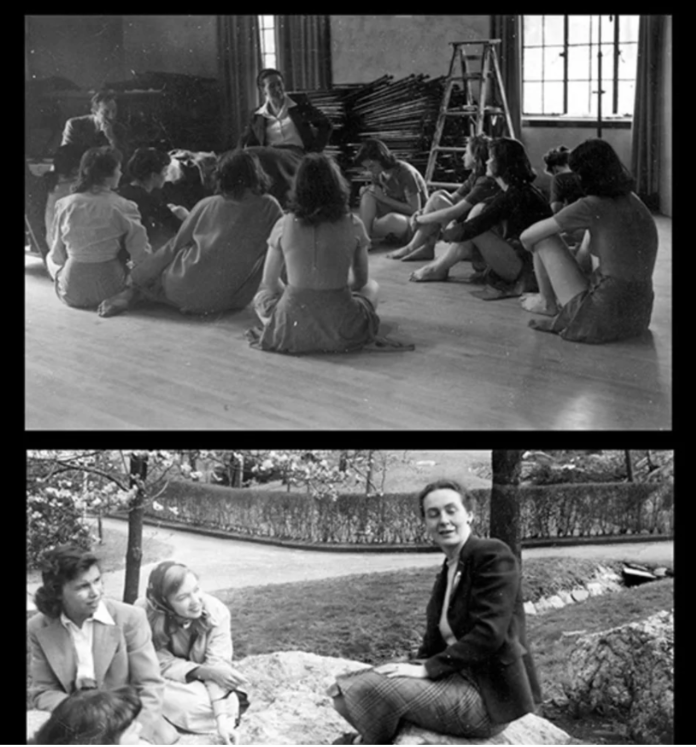
Bessie Schönberg, founder of the Sarah Lawrence Dance Department, teaches a group of students on campus in the 1930s (top) and in 1945 (bottom). Image courtesy of the Sarah Lawrence College website.
Bessie Schönberg. Lucinda Childs. John Jasperse. Since its inception at Sarah Lawrence College in 1938, the Dance Department has produced some of the most recognizable names in modern and postmodern dance history to date. Now, their numbers are dwindling, and nobody seems to know — or agree — as to why. Some chalk it up to decisions made by the director of the program, some chalk it up to the school’s administration and some chalk it up to the intensity of the program itself. Many students on campus, though, know little about the program and its existence to begin with, and fail to recognize the hard work and dedication the dancers at this school possess. What was once a flourishing and thriving program is now a dejected sector on campus. “When I first came,” says Peggy Gould, who started teaching in the program in 1999 and became a tenured faculty member in 2013, “There were somewhere between fifty and sixty Dance Thirds. We’re definitely usually in the single digits at this point. There’s been a precipitous decline.”
Many students become indoctrinated into the Sarah Lawrence Dance Department by mere happenstance, seeking a way to maintain their artistic and athletic practice that has been instilled within them since childhood. The Dance Third’s current structure requires students to take three component classes per semester that equate to one third of their study at Sarah Lawrence: two Movement Practice classes, one component in a Creative Study or one Analytical/Theoretical class. Jasperse, who has been director of the Dance Department since 2016 and is an alumnus of the undergraduate college himself, explains, “It’s useful to talk about different things, but ultimately they’re all kind of informing one another. How we are in our physical body actually challenges the way our thoughts emerge in our mind.” The dance-third is structured to center important movement practices, while surrounding them with the necessary intellectual engagement outside of motion to motivate students to link their studies to their practice.
The way that Sarah Lawrence is organized, first-year students are not permitted to take more than fifteen credits in one semester. Kailani Harrison ‘28, who is a junior at Sarah Lawrence, explains, “If you really want to dance, it’s a third or nothing your first year.” The Dance Department requires students who are enrolled in a third to attend seven classes a week, as opposed to the usual three their peers take. Additionally, students are required to attend a regularly scheduled monthly Dance Meeting, which includes both undergraduate and graduate dance students, complete one Dance Tech/Production class and participate in one Live Time-Based Art (TBA) class. Dancers are also expected to audition for graduate thesis performances throughout the semester. “It’s incredibly draining,” Harrison elaborates, “It’s a lot, and it’s draining.”
Dancers are amongst the most passionate individuals on campus, dedicating themselves and their bodies to the craft. It’s an incredibly exhausting time commitment, and one that takes a physical toll as well. “In order for a collective to be strong and powerful, the strength and power of the collective relies absolutely on the vibrance of each member,” Gould explains. “So one has to have brilliant individuals in order to have that powerful collective.” When you are physically and mentally drained, though, and you feel like your peers neglect to offer you the support they should, it can be hard to commit to the strict schedules, questionable leadership and physical exertion the Department requires. It can be difficult to maintain the vibrancy necessary for a unified and successful program — especially if you feel like the structure of the program itself is shifting.
The Dance Department no longer offers a wide variety of different technique classes as it once did, and there are not very many levels available to students from varying dance backgrounds — most Movement classes only have one or two levels. Riley Mulder ‘27, a senior in the Dance Department, has taken a dance-third every semester since her freshman year and is now enrolled in the Dual-Degree Program for Dance Movement Therapy, deplores that these changes in structure have been extremely limiting: “Part of me understands, but as someone who is so committed to the dance program, I don’t like it. It’s been harder to do all of the things that I want to do.” Kali Gethers ‘27, who quit the program after their freshman year and has no desire to return, agrees, “Something needs to be changed in the structure. I think that there needs to be something done for people who are not looking to be choreographers — a lot of people who are dancing here are not hoping to dance professionally.” Though there are certainly a handful of students who wish to seek dance as a career, many are simply seeking a way to continue their passion and continue moving their bodies in ways that challenge and excite them.
Jasperse asserts that he “wants to provide an environment that allows people to … think about how studying dance while they’re in undergraduate could be this totally exciting thing, even if they don’t particularly imagine themselves moving into the field.” Still, because of the lack of support, continuity, and diversity in the program — both in the classes themselves and in the professors — it can be an incredibly difficult sacrifice to make. “I’m so committed to us being an inclusive and inviting community,” Jasperse responds, “So when there are people who are like, I really wish the dance program would do this… I’m not saying in any way that we can necessarily deliver it, but the first step of that is the kind of openness in communication, meaning, you gotta tell me!” Gethers, who quit the program due to a personal dispute with Jasperse, claimed that they did, indeed, confront the director and administration about their qualms, but, “He genuinely does whatever John wants and whatever John thinks is right and doesn’t take into consideration other people.”
Like many other sectors on campus, “There’s a lack of funding in the program,” Harrison explains, “John tries so hard, but we’ve got nothing.” Jasperse elaborates, “I’ve always had to do more with less … I would like to see further investment, but I’m also acutely aware of the challenges to making that happen.” Gould echoes, clarifying, “How the college has been managed, and the resources of the college have been managed, has meant reduction, reduction, reduction, in terms of budget allocation.” For example, graduate students are gifted only $200 a semester to put on a show, dress their dancers in costume, and provide props; Gould, who was previously able to hire a Teaching Assistant for $450 per semester, is unable to find an individual who can survive on the meager $170 now allocated towards their work.
Though many visiting professors overstay their initial welcome, “visiting” to teach over and over and over again, repeatedly returning to the college, there are only two tenured faculty: Jasperse, the Director, and Gould. Jasperse feels as though rotating visiting professors is actually a strong suit of the department, explaining that he has tried to “find a way to diversify the experiences and traditions and voices and backgrounds of the faculty — most of that has happened through the large percentage of guests that we are working with.” Gould claims, though, that “Every opportunity to bring new faculty in is an opportunity to shift the composition of the space itself. I’m not saying that you have to be of a specific constituency to teach about certain things, but it also means that if there is no one who looks like someone — a student or a group of students — it’s a stretch. I think that’s been a part of it, that the composition of the faculty, especially amongst the permanent faculty — which is now just the two of us — is two white people.”
Moreover, amongst the challenges within the program itself, many dancers feel abandoned by their peers on campus, with only a few seats occupied at their shows. “The people who come to the dance shows only come because they know someone who is dancing,” Mulder laments. “I think that the school could be much more supportive of the program,” Harrison adds. “We’re not getting the funding, and we’re not getting the recognition and we’re not getting the commitment. They don’t show up for us like they do for the athletes.” “I think people underestimate the power dance brings,” Jasperse confirms. “We really do have something quite profound and deeply needed.”
Nevertheless, students still return, and dancers still dance. When talking about the number of students involved in the program, Jasperse explains, “We’ve seen a bit of this,” as he raised his hand slowly up a growing imaginary graph, though he could not place a secure reason as to why. “What’s kept me coming back, and what’s kept me engaged, and what has made me love it, is that … everyone comes from such a different dance background,” Mulder explains. “You’re learning so much from your peers, and the graduate students.” Harrison agrees: “A big part of being a dance-third is the kinds of relationships you form. I’ve met a lot of great people through the dance program, so I’ve got a lot I can thank John Jasperse for.”
The Sarah Lawrence Dance Department has three upcoming shows: Open Performance, which takes place on Nov. 12 and 13; TBA Winter Piece, which will occur on Dec. 11 and 12; and Performance Project on Dec. 15 and 16.