When Sustainability Takes a Backseat
Sophie Brown ‘28
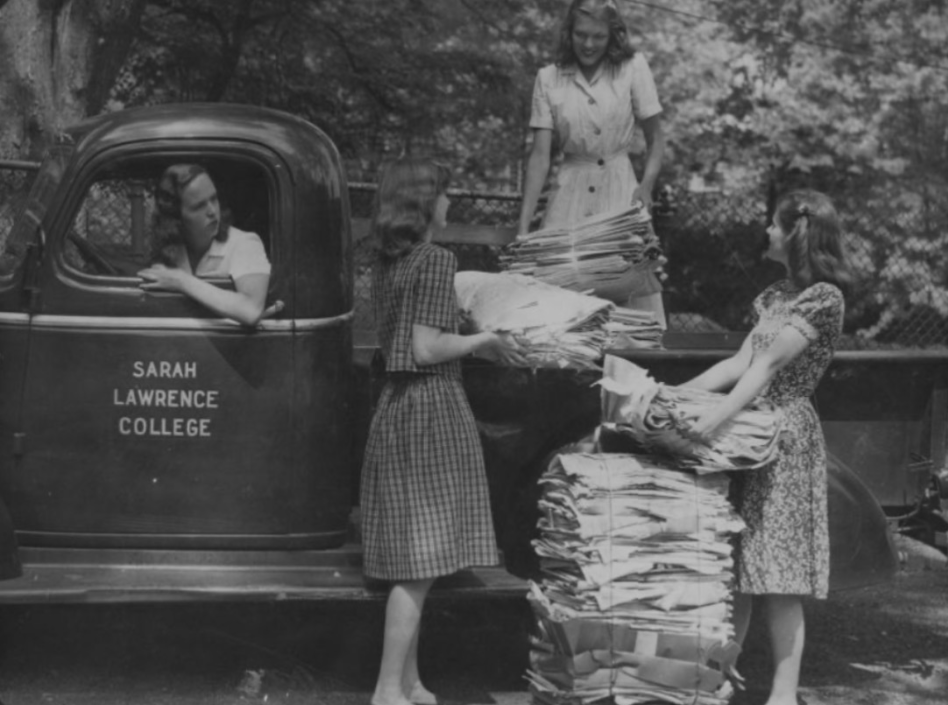
Students Recycling Newspapers During WWII College Archives Photograph Collection. Sarah Lawrence College, 2006. JSTOR.
In the bowels of the campus operations office, past the iconic purple door and up two flights of creaky stairs, sits the office of Maureen ‘Mo’ Gallagher, a space packed to the brim with reusable bags, papers, notes, and spreadsheets of all means and uses. Everyone on campus knows her name; for all Sarah Lawrence College (SLC) students, her name pops up in email after email, a kind of disembodied voice that answers all kinds of campus operations questions. On campus, she slips by the student body easily, often in a baseball hat and a taupe bomber jacket; she sees all. She sits on the board of directors as the sustainability chair, oversees all campus clean-up teams, is the head of campus operations, and she does it all efficiently and bluntly, looking earnestly over her large wire-rimmed glasses.
Mo, who has been working on campus for over 29 years, has hundreds of stories backlogged in her brain of student activity, ranging from the mundane to the truly egregious. She was eager and open when talking about sustainability in tangible ways, consistently attempting to bridge the gap between the efforts of students and her role as sustainability chair. She says she helps plenty of students involved in sustainability efforts on campus with various projects they’re doing for classes or in their personal lives. “We had one student, Sean, who was determined to go through our lighting and water bills, looking for ways we could cut down on usage,” Mo states they saved around $1,000 just by turning off extra lights in the library after hours. She also mentioned that there is a big disparity between students who care and students who don’t. “If I ever showed you the waste that’s left over in some of the rooms, you would be appalled.” She said this about move-out, a sour expression on her face. “There are students that do this during move-out.” Mo pulled up pictures of a vacated dorm room, the walls entirely peppered with small blue dots.
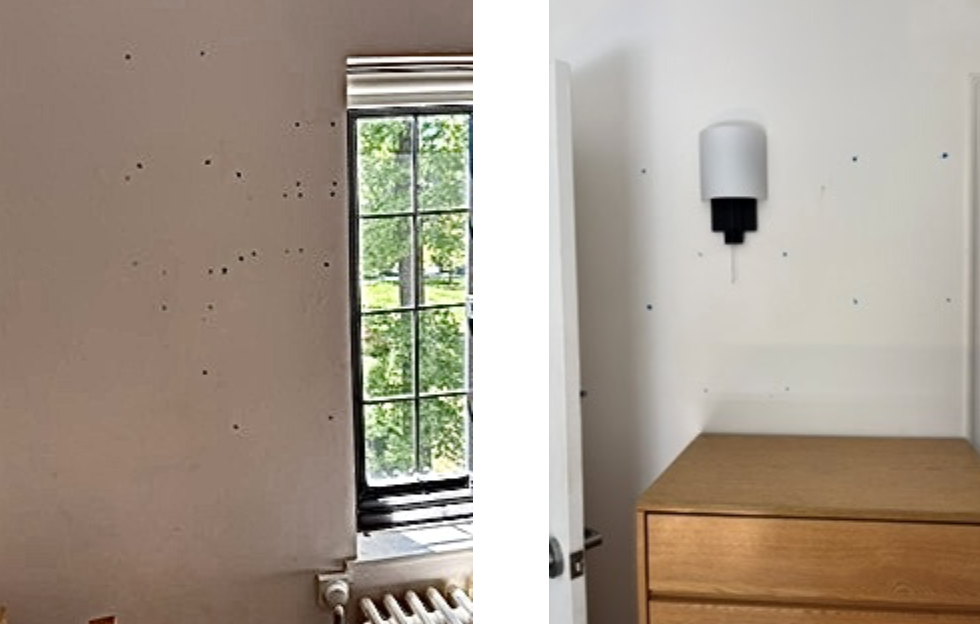
Images by Maureen Gallagher
“They use Blu-Tac, and that’s not something we can clean off. We have to repaint the entire room.” She stated how small the grounds crew is and continues to be, especially with big events such as move-out and move-in. “We have a team of eighteen now, and they all break into teams to tackle the different residence halls.” Eighteen people to clean up the mess of approximately 1,580 students. “Sometimes people leave crock pots of food rotting.”
Nora Penuela ‘29, one of the student leaders of the Environmental Justice Initiative on campus, shares her thoughts: “This is a very prestigious and wealthy school, and the amount of things we consume and throw away, especially the carelessness in which we throw things away is definitely correlated with the amount of privilege we have as students.” This is in response to the trash load generated by move-in on campus, a time in which she notes that anyone can pick up new, unused items from the trash that students buy and discard quickly. In the dining halls, there seem to be issues as well, with the account that “down at Bates I’ve seen pizza slices in the bins marked recycling.” Nora talks more specifically about a dissonance that tends to happen between students involved in environmental issues and those who aren’t as interested. “I feel like for the general population sustainability isn’t always the first thing on people’s minds, not because people think it isn’t important, they’re just hesitant to contribute in real ways on campus and in the world that would make them step outside their comfort zone.”
Mia Juusola ‘27 speaks about her experience with sustainability on campus: “I went to a high school that was incredibly sustainability focused. I think the actual amount of students recycling on campus is small.” She mentions that, on campus, there is very little incentive to recycle and sort into the correct bins due to the nature of the practice. “In Germany and many other countries in Europe, there are specific reasons to recycle. There’s a financial incentive as well as the knowledge that what you’re recycling isn’t going to end up in a landfill.” As an international student, Mia is often surprised by how shrouded in mystery the recycling process can be in the US, all the way to its eventual final destination. Lots of students are, it turns out. The basement of the student residence, Hill House, has bins where one can separate their waste into recycling and trash. There also used to be a composting program, but it has since been discontinued. Erin Abramson-Newman ‘28, a student who lives there, says she sorts her trash into the respective categories before bringing it to the basement, but isn’t sure it’s actually being recycled once it's brought out of the building. “We kind of assume it isn’t being recycled properly, but we separate it anyway because it’s important in the small chance that it is.”
Despite what she’s seen, Mo continues to be optimistic and transparent with students. She says that over the years, it’s been “like night and day” with the amount of waste generated on campus. However, she still pushes that “we need to do a better job of educating, of finding little ways for people to do their part on campus. If students really wanted to, they could fill the gymnasium with stuff that they’d normally throw away,” she added, “And that’s still us getting better every year.”