Sofia Sinclair ‘29
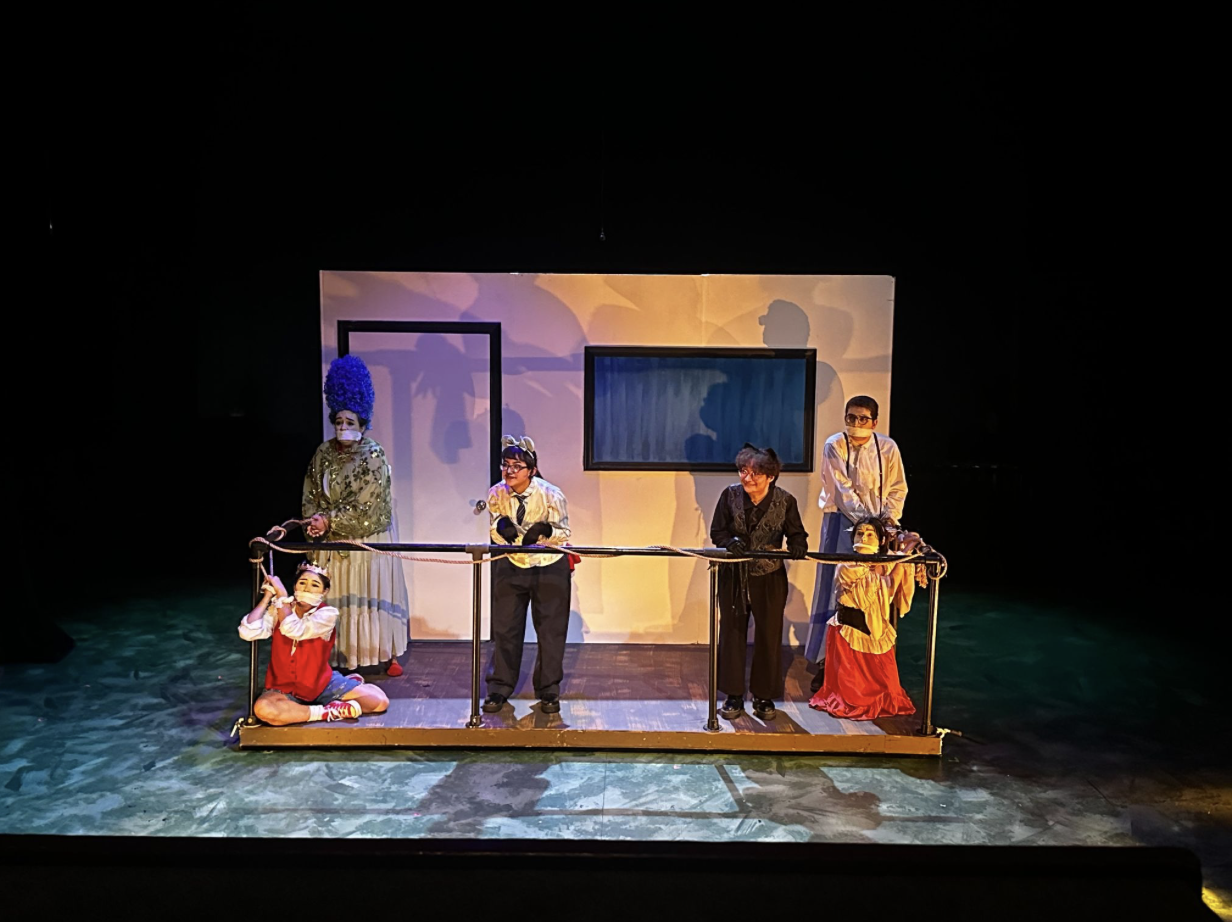
Photo by Sofia Sinclair ‘29
This Halloween, Sarah Lawrence College’s theatre program is offering a different type of scare: a scarily fun show. This year, the theatre program sucks attendees into the incredibly wacky world of Anne Washburn’s Mr. Burns, a Post-Electric Play. Featuring three acts and a 13-person cast, Mr. Burns takes the audience on an 82-year journey that turns beloved characters into beings of myth and legend, all while making people laugh on the way there.
Act 1 opens in a United States without electricity, with a group of survivors sitting around a campfire trying to remember the “Cape Feare” episode of The Simpsons. Act 2 looks at the same group with some new additions — seven years later. Society is still without electricity, and the survivors have formed an acting troupe that performs episodes of The Simpsons for other communities. Finally, Act 3 sends the audience 75 years into the future, where the episodes of The Simpsons have become ritual performances.
Across the three acts, Mr. Burns proved to be the gift that kept giving, with each act turning out better than the last. Following the story progression, the performance continued to pick up speed throughout the show, eventually culminating in the climactic final act. The seven leads are brought to life by Cosmo Moffett ‘28 as Matt/Scratchy, Madeleine Bohn ‘27 as Jenny/Marge, Red Muniz ‘30 as Maria/Itchy, Lucy Weinstein ‘27 as Sam/Burns, Morgan Goldsberry ‘28 as Colleen/Lisa, Griffin Kromback ‘30 as Gibson/Homer, and Juliette Mauvilain ‘30 as Quincy/Bart. All of them bring uniqueness, comedy, and, ultimately, meaning to the characters they portray. The actors handle the transitions between comedy and fear effectively, without straying too far into either one. The show becomes more enjoyable as it continues, and a major reason why is the cast members.
Additionally, Mr Burns features quite a few acapella sections, and those “musical mongerings” were far from off-key. They’re funny and yet intricately arranged by music director Kate Cornyn ‘27 and director Liza Couser ‘28. According to Cornyn, the Mr. Burns cast did not come in with prior acapella experience. Despite that fact, the acapella sections are entertaining and, frankly, impressive. This, too, is in part because of the chorus/ensemble that is seen in Act 3, which bolsters the already strong vocal production.
On the production side of the show, the design work throughout is wonderful. The set design was handled by Conner Wood ‘29, who came up with the three distinctly different sets. The usage of space in the Wright Theatre is imaginative. The lighting design is intentional from start to finish. The sound design was sometimes too loud, but still served a purpose that cannot and should not be underestimated. What was striking was the employment of live music during the non-acapella sections as opposed to a backing track. While a small detail, it worked to fulfill the sense of being in a post-electric world.
With a runtime of about 2 hours and 30 minutes — including a 15-minute intermission — Mr. Burns tells a complete story with themes about oral tradition, cultural memory and the place of pop culture and art within society. Though the show starts slowly in Act 1, by Act 2 the production is at its best. Mr. Burns was a show that I never would have thought I’d enjoy and demonstrates, without a doubt, that one should never judge a play by its cover.